- ThetaThrottle
- Posts
- The Danger of "Obvious"
The Danger of "Obvious"
Weekly Edition: April 15th, 2026
Market Movements
Current Level | Weekly Return | YTD | |
|---|---|---|---|
S&P 500 | 6,967.38 | 3.154% | 1.78% |
NASDAQ | 23,639.08 | 3.584% | 1.71% |
Dow Jones | 48,535.99 | 3.316% | 0.98% |
VIX | 18.36 | -12.446% | 22.81% |
Russell 2000 | 2,705.67 | 4.219% | 8.20% |
*Weekly Return is calculated as market open of the previous Wednesday, to market close this Tuesday (yesterday); Current Level is Tuesday’s (yesterday’s) close.
Weekly Rollout
The market likes the idea of peace
Even though things are green, a survey shows investors bracing
What will the US growth be for 2026?
Rates will very likely hold in April
Big Bank Earnings: What is the deal?
Thought Throttle
Most new traders and investors don’t fail because of their strategy. They fail because of misaligned expectations.
Options trading, like most skills, follows a very predictable psychological curve. This phenomenon is called the Dunning-Kruger Effect.
Basically, early on, with limited experience, everything feels simple and obvious. Confidence is sky high. Then reality sets in, confidence drops, and many quit right when the real learning begins.
But those who persevere, get back to an informed and reasonable confidence.
Here are the stages most option sellers go through—and why understanding them matters:
The Peak of Early Confidence (Mount Stupid)
We sell our first few options. They expire worthless. Premium comes in nicely. A 25 delta feels “safe.”
The process seems repeatable and straightforward. We think things like, “This is easier than everyone says.”
The Valley of Reality (or Despair)
The market eventually tests a trade, or more often, multiple trades. A strike gets breached. A loss lands that actually hurts our portfolio.
Suddenly the same strategy feels unreliable or broken. We may start questioning everything. Our entries, our sizing, even whether options selling actually works.
The Misunderstanding Most People Have
This dip isn’t a sign that the strategy is broken. It’s a sign we’re finally seeing the full picture.
Obviously, it isn’t that easy (or everyone would do it and be rich).
Premium isn’t “easy money.” It’s compensation for real risk.
The Climb Back Up (Slope of Enlightenment)
If we stay with it, our perspective shifts. We stop asking “Will this work every time?” and start asking “What does this look like over the long run?”
A 25 delta can’t simply be written off as “safe.” There is a legit risk.
Understanding begins to shine through and we start to comprehend what the trade actually is, not what we hoped it would be.
The Real Edge Emerges (Plateau of Sustainability)
We realize option selling favors process over prediction, patience over perfection, and probabilities over hope.
We start aligning our trades with businesses and price levels we already like. The game finally starts to make sense.
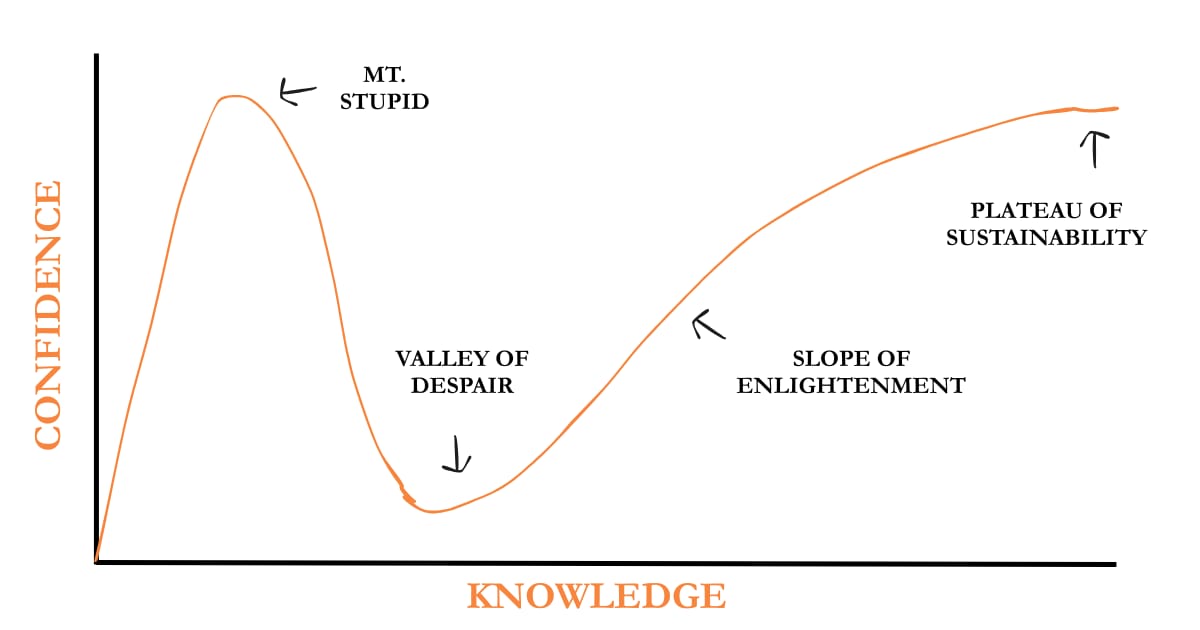
Most traders never make it past the valley. The drop in confidence is taken as a failure, not progress.
Not the case.
It means they’ve graduated from the beginner illusion to actually seeing the terrain.
In my experience, the danger in utilizing options comes from expecting it to work differently than it actually does.
Align with the truth.
Stay long enough to climb the curve. Simple, not easy.
Thanks for reading.
“Good-To-Know’s”
Delayed Gratification — the ability to forgo immediate rewards for better long-term outcomes.
Nothing hurts options trading more than a lack of patience.
Over time, losses will appear, trades will take longer than expected, and results will rarely feel clean or linear.
Using theta successfully requires the discipline to let time do its work.
After all, it is called time decay, lol.
Quote(s) I Like
“Confidence is the feeling you have before you fully understand the situation.”
“It ain’t what you don’t know that gets you into trouble. It’s what you know for sure that just ain’t so.”
Trade Mechanics
Just a real quick look at a CSP on Microsoft (MSFT).
MSFT is currently trading at 393.11.
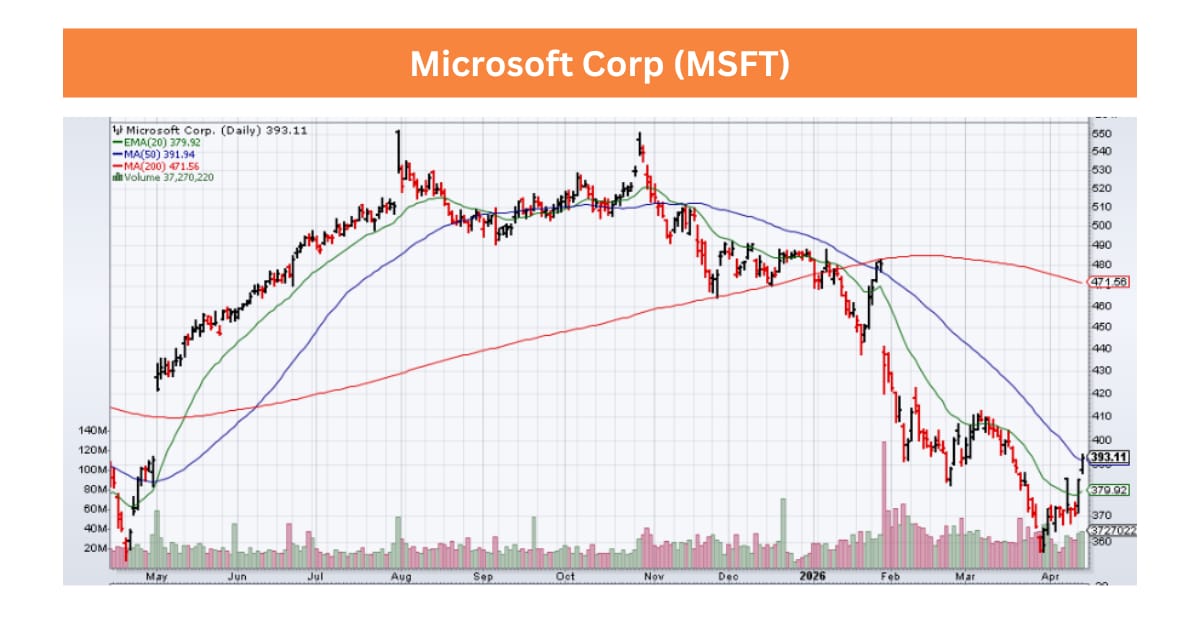
If we would be happy to buy 100 shares of Microsoft, then a CSP may be what we’re looking for.
Maybe we love MSFT’s cloud dominance, the AI integrations in its ecosystem, or the fact that it is trading at about a 16.6% discount to its 200-day moving average ($471.56).
Whatever the case, we could enter into a CSP to earn some premium while signing up to potentially buy the shares.
We could sell the May-15-2026 $375 Put Option (~30 Delta) and receive a premium of about $9.30, or $930.
At expiration, if MSFT is…
Below $375 → We would be assigned to buy 100 shares at a $365.70 cost basis.
Above $375 → We would keep the $930 in premium, which is about a 2.54% return in just 31 days (about 34.40% annualized).
Just an illustration. As always, do your own research. Best of luck.
Throttle Q&A
Why Does My Confidence Drop the More I Trade?
You’re not getting worse. You’re finally seeing the full picture.
Early confidence (or arrogance) comes from ignorance of risk.
Real confidence comes from understanding it and moving through it.
How Do I Know If I’m in the Valley or If the Strategy Just Doesn’t Work?
If you’re still following your rules and process but feeling doubt and frustration after reasonable losses, you’re likely in the valley.
A strategy’s brokenness should be evaluated after extended disciplined execution where consistent negative expectancy appears over time.
Until then, most rule-breaking, plan-switching, etc., is usually an emotional reaction.
Is Selling Options Harder Than It Looks?
I don’t necessarily think that it’s harder than it looks. But it is different than it looks.
The difficulty is rarely in the mechanics, but in the psychology.
At least that’s the case for me.
Got any questions or comments? Feel free to reply to this email—we’d love to hear from you!
If you found this helpful, feel free to share or forward this email to anyone who might be interested! We appreciate your support.
Disclaimer
The information provided in this newsletter is sourced from reliable channels; however, we cannot guarantee its accuracy. The opinions expressed in this newsletter are solely those of the editorial team, contributors, or third-party sources and may change without prior notice. These views do not necessarily reflect those of the firm as a whole. The content may become outdated, and there is no obligation to update it.
Options come with inherent risks. We strongly advise you to consult with a financial advisor before making any investment decisions, including determining whether any proposed investment aligns with your personal financial needs.
