- ThetaThrottle
- Posts
- Ending the Year Steady
Ending the Year Steady
Weekly Edition: December 31st, 2025
Market Movements
Current Level | Weekly Return | YTD | |
|---|---|---|---|
S&P 500 | 6,896.24 | -0.126% | 17.25% |
NASDAQ | 23,419.08 | -0.581% | 21.27% |
Dow Jones | 48,367.06 | -0.119% | 13.69% |
VIX | 14.33 | 1.703% | -17.41% |
Russell 2000 | 2,500.59 | -1.526% | 12.25% |
*Weekly Return is calculated as market open of the previous Wednesday, to market close this Tuesday (yesterday); Current Level is Tuesday’s (yesterday’s) close.
Weekly Rollout
The year-end thin trading volumes leave the market relatively flat
There is only a 15% chance of a rate cut at the January Fed meeting
Powell is still on the chopping block for the upcoming Fed chair pick
Analysts see continued upside for U.S. stocks based on a few metrics
Short-dated index options now make up a majority of SPX options volume
An ounce of silver is now worth more than a barrel of oil
“Good-To-Know’s”
Outcome Bias — the tendency to judge the quality of a decision based on how it turned out, rather than on the information and logic available at the time the decision was made.
It is possible for good decisions to produce bad outcomes, and conversely, for bad decisions to produce a good outcome. When outcomes—especially a few short-sighted, limited outcomes—become the sole standard, sound processes are abandoned.
Not because they are flawed, but because a fluke seemingly invalidated the original thesis. This bias quietly erodes consistency by rewarding luck and punishing discipline.
It is so important to weigh the quality and quantity of evidence when tuning a plan/strategy. Sound strategies are not to be overturned by noise.
Quote(s) I Like
“Show me the incentive and I will show you the outcome.”
“In the short run, the market is a voting machine but in the long run, it is a weighing machine.”
Thought Throttle
As 2025 wraps up, I’ve been thinking a lot about consistency.
Consistency is often treated as a results-based concept. A smooth growth curve? Consistent. Volatile growth? Inconsistent.
But this is misleading. While measuring outcomes is important, there are often mistakes in our actual consistency measurements.
Too commonly, we look at outcomes to decide whether we were disciplined. That’s not the correct framing.
Inputs and outputs are correlated, yes, but they are not the same thing. There are always unaccounted-for variables—statistical likelihoods, unforeseen factors, and sheer randomness—between input and result.
If we judge consistency by outcomes alone, we risk learning the wrong lessons.
True consistency is about repeating the same decisions under different conditions. It’s about applying the same standards over and over again in a multitude of situations or circumstances.
This also means accepting periods of inactivity when our standards don’t give us permission to act. Often, resisting the urge to act incorrectly is true discipline.
Properly waiting isn’t a lapse in discipline. Forcing trades is.
Consistency requires resisting non-factual behavioral changes. Adjustments driven by frustration, recent wins or losses, or calendar pressure aren’t refinement.
They’re drifts.
Before changing anything in a strategy, we should be certain we’ve identified a flaw in the strategy itself, not an emotional response to its execution. The evidence needs to be substantial to reform a proven process.
And there are certainly times when refinement is necessary. But refinement is meticulously intentional, not impulsive.
And over time in this process, consistency and discipline compound. Fewer mistakes are made, steadier behavior is realized, and decisions become less dependent on irrational factors.
Thank you for reading, engaging, and supporting Theta Throttle throughout 2025.
Until next year.
Trade Mechanics
Let’s look at two opportunities for cash-secured puts: one in Walmart (WMT) and one in Netflix (NFLX). Each strike will represent roughly a ~24-delta put expiring February 20, 2026.

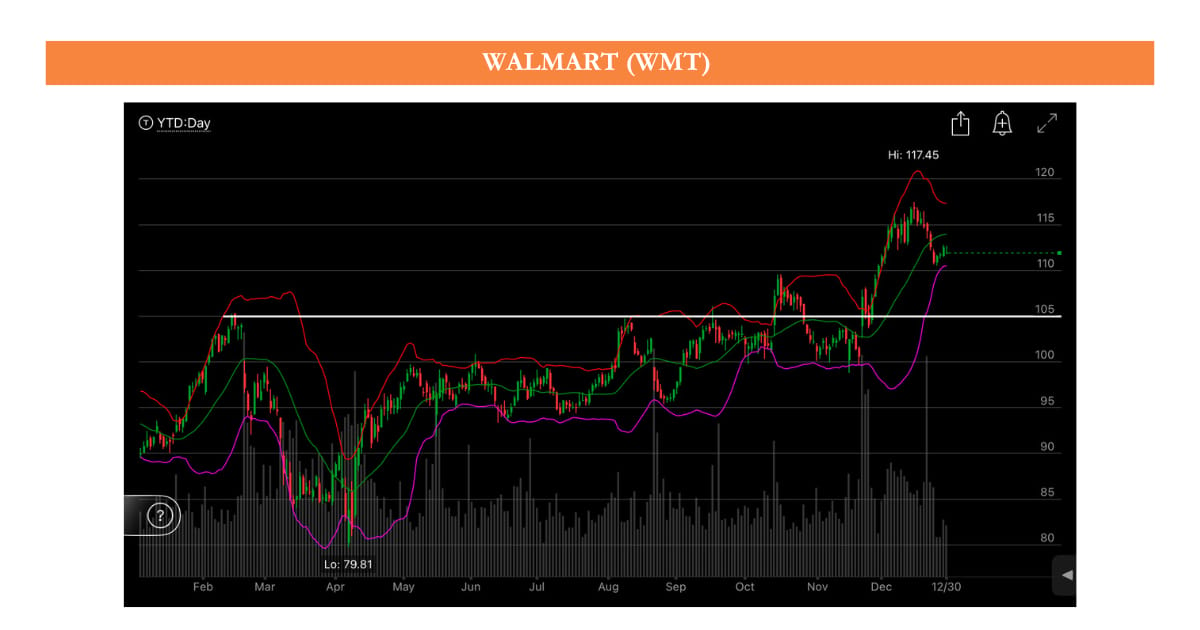
Let’s see how these two options compare:
WMT | NFLX | |
|---|---|---|
Current Price | $111.92 | $93.78 |
Put Sold | Feb 20 ’26 $105 Put (~24 Delta) | Feb 20 ’26 $86 Put (~24 Delta) |
Premium | $1.69 | $2.06 |
Capital At Risk | $10,331 | $8,394 |
Return if Not Assigned | $169 / $10,331 = 1.64% | $206 / $8,394 = 2.45% |
Annualized Return | ≈ 12.06% | ≈ 18.55% |
Cost Basis if Assigned | $103.31 (~7.7% discount) | $83.94 (~10.5% discount) |
If we thought that buying Walmart (WMT) would be acceptable at or below $105, we could sell the $105 Feb 20 Put for about $1.69 in premium. That’s roughly a 1.64% return on risk over 52 days, which annualizes to 12.06%. This a discount of ~7.7% from the current price of $111.92 if assigned.
For Netflix (NFLX), selling the $86 Feb 20 Put yields $2.06 in premium with shares trading near $93.78. That’s a 2.45% return on risk over the same timeframe of 52 days, which annualizes to 18.55%. This is a discount of ~10.5% from the current price if assigned.
Keep in Mind…
Premiums fluctuate with volatility, earnings cycles, and investor sentiment. Returns assume smooth expiration and no early assignment. Wider spreads may appear on less-liquid strikes. Both positions require roughly $10k in collateral and reward patience over prediction.
This is for educational purposes only—not a trade recommendation. Remember to always do your own due diligence and consult a financial advisor before making investment decisions.
Throttle Q&A
The Profits You Don’t See on a Statement
Many of our best trades are ones that don’t appear on our statements. This is because many of the most impactful decisions are preventive, not additive. Avoided trades don’t leave a mark on performance summaries, but they are necessary to healthy returns.
Behavioral wins like skipping low-quality setups, resisting calendar pressure, or staying inactive during thin holiday weeks reduce risk without producing visible “returns.” Over time, these non-events compound just as meaningfully as profitable trades.
How Do You Know When a Strategy Needs Adjustment, Not Abandonment?
Start by separating structural issues from short-term variance. Things like persistent liquidity problems, unintended risk concentration, or exposure that exceeds defined limits are typically design flaws, not market noise.
Variance, on the other hand, creates uneven results without breaking the rules. Drawdowns and streaks are expected in probabilistic systems. When assumptions hold and rules are followed, poor outcomes alone aren’t evidence of failure.
Adjustment should come from clarity, not reaction. Refinement tightens definitions (deltas, duration, sizing, exits) while preserving the strategy’s core logic.
Abandonment is appropriate when the structure does not fit the market nor the trader’s risk tolerance. When something is fundamentally flawed or in error, best not stay on a sinking ship.
Got any questions or comments? Feel free to reply to this email—we’d love to hear from you!
If you found this helpful, feel free to share or forward this email to anyone who might be interested! We appreciate your support.
Disclaimer
The information provided in this newsletter is sourced from reliable channels; however, we cannot guarantee its accuracy. The opinions expressed in this newsletter are solely those of the editorial team, contributors, or third-party sources and may change without prior notice. These views do not necessarily reflect those of the firm as a whole. The content may become outdated, and there is no obligation to update it.
Options come with inherent risks. We strongly advise you to consult with a financial advisor before making any investment decisions, including determining whether any proposed investment aligns with your personal financial needs.
