- ThetaThrottle
- Posts
- Averages in Motion
Averages in Motion
Weekly Edition: February 18th, 2026
Market Movements
Current Level | Weekly Return | YTD | |
|---|---|---|---|
S&P 500 | 6,843.22 | -1.910% | -0.03% |
NASDAQ | 22,578.38 | -3.007% | -2.86% |
Dow Jones | 49,533.19 | -1.413% | 3.06% |
VIX | 20.29 | 13.542% | 35.72% |
Russell 2000 | 2,646.59 | -1.990% | 5.84% |
*Weekly Return is calculated as market open of the previous Wednesday, to market close this Tuesday (yesterday); Current Level is Tuesday’s (yesterday’s) close.
Weekly Rollout
S&P 500 and NASDAQ edge higher slightly after a 3-day weekend.
The Fed is looking like it’s going to hold rates for a little while
In fact, there is a ~92% chance the rate remains at the March 18th meeting
Microsoft and Nvidia, best of buds?
Wall Street fear unlocked: Did we overbuild the AI empire?
Good news for banking jobs
Option traders are bullish in select stocks and buying puts heavily in others.
“Good-To-Know’s”
Mean Reversion — a theory that says prices of assets will eventually return to their historical average.
Prices almost never travel in straight lines. When they stretch too far above or below their typical range, gravity often takes over. The “mean” acts like an anchor.
The “mean” can be defined in different ways—perhaps a moving average of the stock’s price, a long-term trend, or a statistical baseline. Regardless of the method, the idea holds: Extreme deviations from the usual are often temporary.
Don’t oversimplify to the point of misunderstanding.
“It went up too much, so it has to come down.”
That’s not the theory.
The mean is not static. It moves. It evolves with price. A moving average drifts. A trend adjusts. The anchor shifts over time.
And the mean includes the asset’s personality.
If a stock historically swings 8–10% in a week, reversion may still involve 8–10% swings. Wild movement may be normal. Mean reversion in a utility looks different than mean reversion in high-growth tech.
When considering this, remember the difference between tendency and certainty.
Quote(s) I Like
“The market can remain irrational longer than you can remain solvent.”
“It’s not supposed to be easy. Anyone who finds it easy is stupid.”
Thought Throttle
Technical analysis can quickly turn into a headache-inducing overload of information if you’re not careful.
There are dozens of indicators. Oscillators. Bands. Clouds. Lines on top of lines on top of lines. And if you stare at enough of them, you can usually bend a case to confirm whatever conclusion you already wanted to reach.
That’s the potential danger.
On the other hand, technical analysis can be helpful in showing us a clearer picture. When done right, it provides context.
But too many traders treat it as an infallible prediction. It becomes less about understanding risk and more about convincing yourself you’re right.
Long story short, technicals can be taken too far. But they are still beneficial to know.
And one indicator that is simple enough, objective enough, and grounded enough to be worth understanding is—the moving average (MAs).
Moving averages are exactly what they sound like. It is legit just the average price over the last X periods. Commonly used timeframes are 20-day, 50-day, and 200-day moving averages.
Why Do We Care?
Well, moving averages do tend to act as support and resistance. Not because the line itself has power, but because sentiment typically anchors to these averages.
If price pulls back toward a widely watched average, buyers often step in. On the other side, if price extends below an MA, rallies back toward it can meet selling pressure.

Moving averages also interact with one another.
When the shorter-term moving averages start crossing beneath longer-term ones, it can signal slowing momentum. The same goes for when a shorter-term crosses above a longer-term MA.
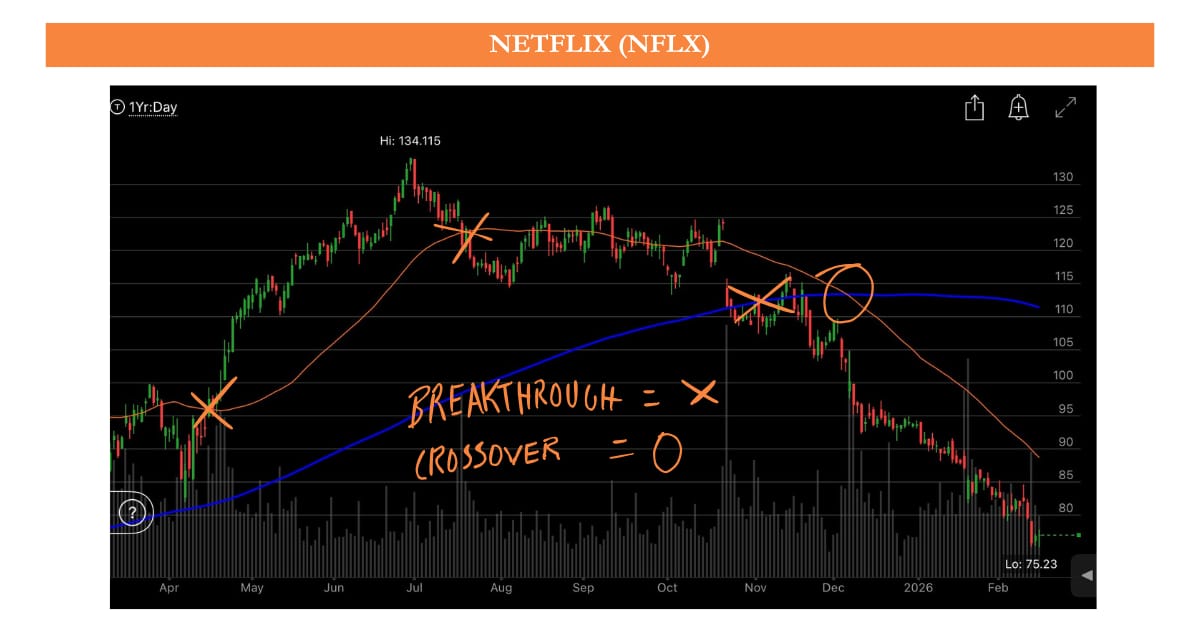
This is usually due to some sort of shift or catalyst. See the images above.
Now, How Does This Apply to Options?
If you sell a cash-secured put while price is stretched far above a short-term moving average, you may be in the middle of a short-term overextension. The risk that the stock reverts to its lower, average price could be higher.
That doesn’t mean price must fall. It simply means the distance between price and its recent average has widened.
I’ve made the mistake before of thinking, “It’s too far above the average. It has to come back.”
Sometimes it does. Sometimes it keeps climbing.
When this happens, you may no longer be dealing with a steady drift, but real momentum.
And momentum can last longer and be more extreme than you expect.
Being far from a moving average doesn’t guarantee reversion—especially the specific and constrained type of reversion that we are often looking for. It just means price has stretched away from where it’s been comfortable recently.
But it’s a moving average.
It isn’t a fixed magnet sitting on the chart. If price runs higher for weeks, the average rises with it. So even when “reversion” happens, it might not look the way you imagined.
Bringing Us Back…
There is so much more information and so many methods of using moving averages that I couldn’t, nor do I want to, cover them all.
Just remember, MAs don’t tell you what will happen, but help show where price has been accepted.
Still, recognize that fundamentals of the company should carry more weight.
In my experience, technical-heavy trade ideas have a tendency to trail too far off into theoretical land—a place where trade ideas go to get humbled.
I like to stick with what works for me, and that is simply selling options strategically based on the underlying company, not the underlying stock.
Trade Mechanics
Let’s look at one opportunity for a cash-secured put in Advanced Micro Devices (AMD). The $180 strike used represents roughly the 24-delta put expiring March 20th, 2026.

Let’s take a closer look:
AMD | |
|---|---|
Current Price (Today) | $203.08 |
200-Day Moving Average | $182.48 |
Put Sold | Mar 20, 2026 $180 Put (~24 Delta) |
Mid-Premium | $5.10 |
Capital At-Risk | $18,000 − $510 = $17,490 |
Return if Not Assigned | $510 / $17,490 = 2.92% |
Annualized Return (31 DTE) | ≈ 40.27% |
Cost Basis if Assigned | $174.90 (~13.9% discount) |
With shares trading near $203.08, AMD sits above its 200-day moving average, currently at $182.48.
By selling the $180 March 20th put, we position ourselves slightly below that moving average.
If AMD drifts toward its 200-day, we are still collecting premium.
If price stabilizes around that longer-term trend, the option can decay favorably, and we keep our entire $510 in premium.
If shares break meaningfully below the 200-day, we would be assigned at an effective $174.90 cost basis, nearly 14% below today’s price.
Keep in Mind…
Premiums fluctuate with volatility, earnings cycles, and sentiment. Moving averages are widely watched but not guarantees of support. Returns assume smooth expiration and no early assignment. This position requires approximately $18,000 in collateral and relies on patience and discipline.
This is for educational purposes only—not a trade recommendation. Remember to always do your own due diligence and consult a financial advisor before making investment decisions.
Throttle Q&A
Does a Lower Percentage Return Mean a Worse Trade?
Not necessarily. The ideal return depends on your risk appetite, along with other factors focused on in personal finance. Higher returns often come with higher volatility and risk. Lower returns could still be a better overall fit for you if they align with your goals and comfort level with risk. As in most of finance, it is about the dance between risk and reward.
Should I Avoid Selling Puts If the Price is Below a Moving Average?
It depends on why price is below the MA. A temporary dip or correction is different from a sustained breakdown of the company. The average doesn’t answer the question for you. That should depend more on the fundamentals. But the MAs give us context.
Does Mean Reversion Mean Things Calm Down?
Not necessarily. Reversion recenters price, but it doesn’t erase volatility. A historically volatile stock may revert with equally volatile moves. The personality of the asset still matters.
Got any questions or comments? Feel free to reply to this email—we’d love to hear from you!
If you found this helpful, feel free to share or forward this email to anyone who might be interested! We appreciate your support.
Disclaimer
The information provided in this newsletter is sourced from reliable channels; however, we cannot guarantee its accuracy. The opinions expressed in this newsletter are solely those of the editorial team, contributors, or third-party sources and may change without prior notice. These views do not necessarily reflect those of the firm as a whole. The content may become outdated, and there is no obligation to update it.
Options come with inherent risks. We strongly advise you to consult with a financial advisor before making any investment decisions, including determining whether any proposed investment aligns with your personal financial needs.

1